Story time (connected speech)
One day Sparky the star found a lion. Next to it was a leaf and a lemon. "Wow!" said Sparky. Then Sparky saw a ladybug and a lollipop. What a great day!
Tongue tip up behind the top teeth, voice flowing around the sides.
American English pronunciation model · voiced · tongue tip (alveolar) · lateral approximant · spellings: l, ll
This page practises English sounds — the words and sentences stay in English on purpose.
/l/ · Sideways air sound
Articulation visual awaiting professional review — not yet checked by a speech and language therapist.
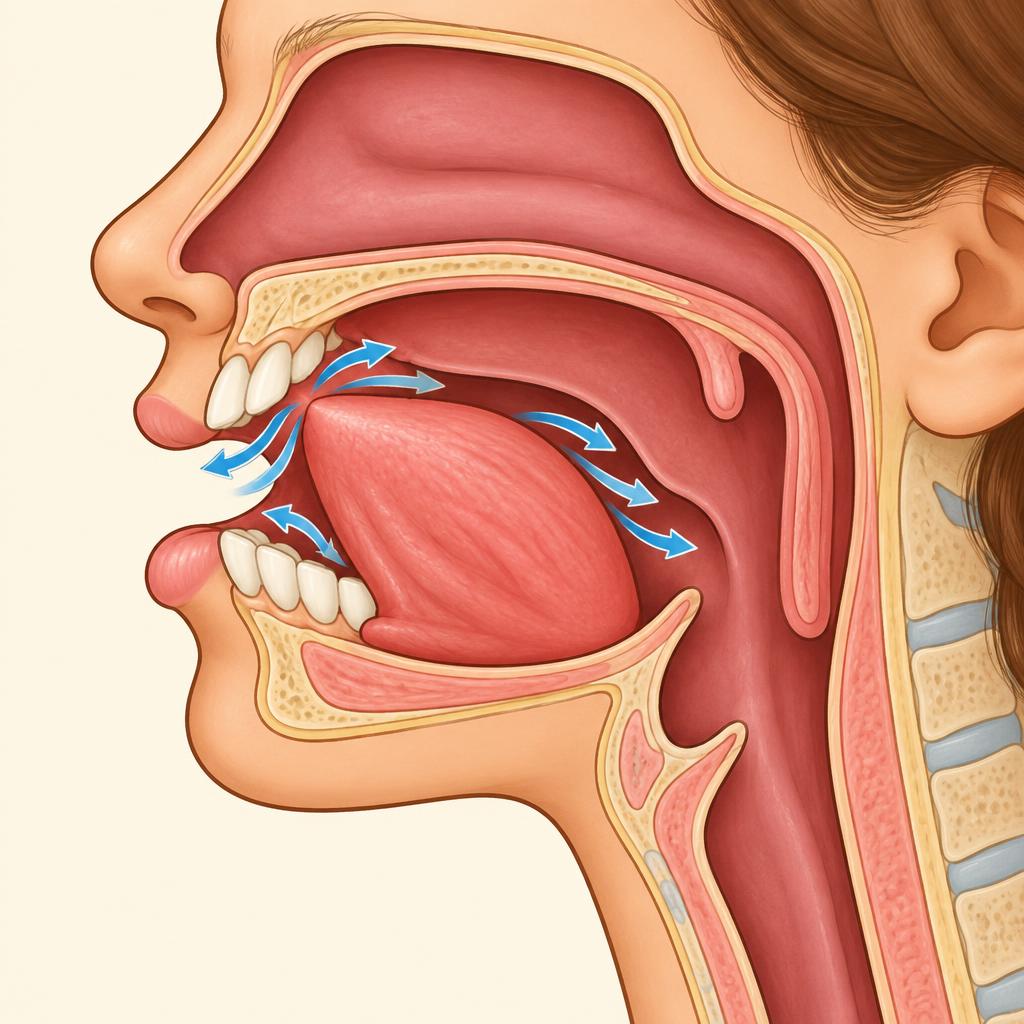
Voice on · feel the buzz · Airflow
Lift your tongue tip behind the top teeth; air passes around its sides.
The tongue tip contacts the ridge while air passes beside the tongue.
Movement 1/3: Tip meets ridge
The camera view stays on this device. Nothing is recorded, saved or uploaded.
/l/
Voice switched ON
Put your hand on your throat — you should feel a buzz.
Remember it: Lifting sound — tongue tip up and sing.
Step by step
More than one right way: At the ends of words ("ball") British English often uses a "dark L" made further back, and many accents (including London English) vocalise it so it sounds like a vowel ("baw"). This is normal for many children's accents. Target the L your child hears around them.
Step up gradually
A sound can be easier on its own than in connected speech. Move on only when your child is saying it accurately and feels ready — not just because a worksheet is finished. Read the Parent Guide
Tongue tip up behind your teeth and sing: lalala.
This device can't record audio, so listening back isn't available here. Practise with the model sounds instead.

lion
/l/ · initial
“my lion”

leaf
/l/ · initial
“my leaf”

lemon
/l/ · initial
“my lemon”

ladybug
/l/ · initial
“my ladybug”

lollipop
/l/ · initial
“my lollipop”

log
/l/ · initial
“my log”

balloon
/l/ · medial
“my balloon”

yellow
/l/ · medial
“my yellow”

melon
/l/ · medial
“my melon”

pillow
/l/ · medial
“my pillow”

koala
/l/ · medial
“my koala”

ball
/l/ · final
“my ball”

bell
/l/ · final
“my bell”

owl
/l/ · final
“my owl”

snail
/l/ · final
“my snail”

whale
/l/ · final
“my whale”

flower
/l/ · in /fl/ blend
“my flower”

clock
/l/ · in /kl/ blend
“my clock”

plane
/l/ · in /pl/ blend
“my plane”

blue
/l/ · in /bl/ blend
“my blue”

glove
/l/ · in /gl/ blend
“my glove”

slide
/l/ · in /sl/ blend
“my slide”